What is Accounting?
Definition:
The orderly and systematic recording of the monetary values of financial transactions of individuals or business enterprises and the reporting of the results of such recording by way of preperation of financial statements to enable the users of the information obtained in this way to make decisions.
Consists of the following 3 activities:
- Identify relevant economic activity.
- Record monetary value of economic event, to provide permanent history of financial activity.
- Communicate recorded information to interested users.
Important!
Accounting Involves the recording of transactions in order to provide useful information of decision-making.
Objective is to provide the user of financial information with enformation to answer the following questions;
a) Did the entity trade at a profit or loss?
b) What was the income of the entity and what expenses were incurred in producing that income?
c) How much does the entity owe?
d) How much do customers owe the entity?
e) What is the nature of assets that the entitiy possesses and what is the amount of the various kinds of property and other assets that the entity possesses?
f) What is the amount of the entity 's capital (equity)?
Bookkeeping vs Accounting-
Bookkeeping is mainly confined to recording of financial transactions. e.g. Accounting includes bookkeeping, but bookkeeping is not accounting
The Nature of Accounting- Accounting is a specialized form of communication, conveying financial information through words and figures to users. Understanding accounting concepts helps interpret financial statements. It's essential for managing both personal and organizational finances, serving as a language for conveying financial information effectively.
The purpose of accounting-
Provides financial information to users;

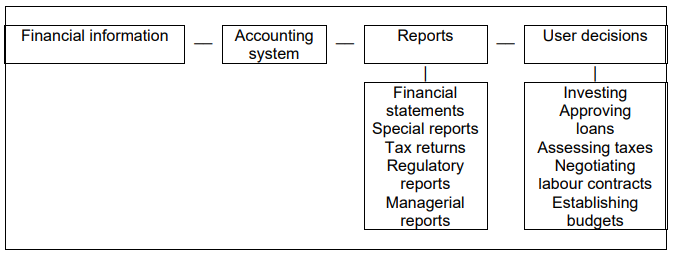
Accounting serves as a specialized medium for communicating accurate and comprehensive financial information, crucial in the business world. Its aim is to provide quantitative financial data to answer key questions about an entity's financial health, such as its ability to generate income, manage expenses, inventory levels, expansion feasibility, and pricing policies. This information is typically found in accounting reports.
The accounting process
Financial accounting operates as an information system, pivotal for making significant decisions based on reported results in financial statements. Business transactions are consistently measured, classified, summarized, and recorded in what's known as the financial accounting cycle.
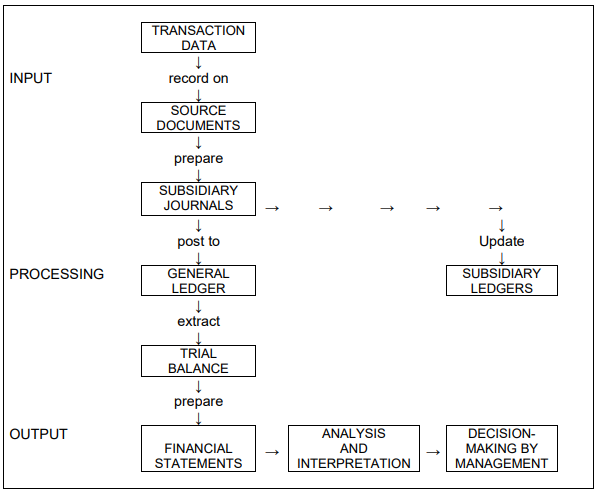
Financial accounting involves systematically recording an entity's financial transactions to ensure readily available information. This process, known as the financial accounting cycle, encompasses various elements. The processing stage, including transaction recording, is termed bookkeeping. The ultimate objective of the input and processing stages is to prepare financial statements.
Why study accounting?
Accounting is the study of methods that enable the orderly and systematic recording of all proceedings or activities in an entity.
Advantages for an individual-
- Enablement to understand business terms and concepts and to apply them.
- Promotes logical thought processes.
- Teaches to plan and systemise own finances.
- Teaches to work accurately.
- Develops sense of responsibility.
- Teaches the value of money.
Advantages for an entity-
- Communicates financial information to the user
- Enables entity to keep accurate records of daily business activity
- Enables entity to determine profit or loss.
- Enables entity to calculate value of assets and liabilities.
- Enables entity to function effectively and efficiently.
Developments in Accounting
Accounting is essential for individuals and entities engaging in economic activities, facilitating recording and reporting of financial transactions. Its historical development, influenced by economic and social changes, led to the establishment of standardized methods. Modern accounting traces its origins to Luca Pacioli's work in 1494, introducing the principle of double entry. While initially manual, accounting processes now increasingly utilize computers. Standardization ensures uniformity, with South African GAAP aligned with international standards like IFRS. These standards, governed by the Financial Reporting Standards Council, aim to ensure consistency in recording transactions, facilitating comparability among financial statements.Accounting is essential for individuals and entities engaging in economic activities, facilitating recording and reporting of financial transactions. Its historical development, influenced by economic and social changes, led to the establishment of standardized methods. Modern accounting traces its origins to Luca Pacioli's work in 1494, introducing the principle of double entry. While initially manual, accounting processes now increasingly utilize computers. Standardization ensures uniformity, with South African GAAP aligned with international standards like IFRS. These standards, governed by the Financial Reporting Standards Council, aim to ensure consistency in recording transactions, facilitating comparability among financial statements.
The function of accounting
Accounting is a specialised method of communicating financial information about an entity and its activities to interested persons or entitites.
Accounting is a process that involves three activities:
- Identify and select events that are evidence of economic activity relevant to entity.
- Recording monetary value of economic events to provide permanent history of financial activitites. Keeping chronological diary of measured events in an orderly and systematic manner.
- Communicate recorded information to interested users. Information is communicated through preperation of accounting reports, most common financial reports;
- Statement of financial position
- Statement of profit or loss and other comprehensive income
- Statement of changes in equity
- Statement of cash flow
- notes comprising a summary of significant accounting policies and other explanatory notes.
The word "entity" does not always refer to business entity, could be an educational/religious institution, or private household.
Universal accounting denominator
All of an entity’s transactions are converted into monetary values before they are processed. Using money as the common denominator, however, has two important limitations:
- Not all events can be expressed in monetary terms
- Value of money is unstable and influenced by many economic factors.
The entity concept
All business entities can be narrowed down to two types;
Service entities-
These types of entities render services for a fee.
Trading entities-
These types of entities specialize in buying and selling of merchandise.
Important to note, some businesses render services and sell merchandise.
A business is seen as an entity that is completely separate from its owner(s). The different forms of business ownership is ;
- a sole trader
- a partnership
- a close corporation
- a profit company, like a state-owned company, a private company, a personal liability company and a public company
- a non-profit company for public benefit
Users of financial information
Financial statements are prepared and presented at leas once a year-
Following categories of users, and their need for information exist;
| User |
Information needs |
| Clients/customers of an entity... |
to assess the ability of entity to continue as a going concern |
| Employees... |
to assess the ability of their employer to provide stable employment and remuneration |
| Government and its agencies... |
to regulate activities of enterprises, to compile statistics and to determine resource allocation and tax policies |
| Investors... |
to assess the risk of investing in an enterprise and expected return on investment. |
| Lenders... |
to assess ability of enterprise to pay interest on loans and to repay loans |
| Suppliers & other trade creditors... |
assess the ability of an enterprise to pay amounts owed |
| Management of an enterprise... |
for planning purposes, determining future actions to be taken or the exercise of control, evaluating the current situation of the enterprise taking corrective steps if needed |
| The public... |
particular entity's contribution to the economy, creation of word, taxes and charitable causes |
Users of financial statements need information on whether the reporting entity has made efficient and effective use of the resources provided to it through the respective equity and/or debt investments. This is known as the stewardship concept. In recent times this notion has manifested itself in concepts such as corporate governance and accountability.
The fields of accounting
Users can be subdivided into the following-
- Internal Users - management and employees
- External Users- investors, creditors and government
Financial accounting is concerned with the provision of financial information to external parties for the most part, while management accounting is concerned with the provision of financial information to people within an entity.
Financial Accounting
Financial accounting involves the measurement and recording of transactions within an entity, leading to the periodic preparation of financial statements. These reports serve various stakeholders such as managers, owners, creditors, and governmental agencies, providing insights into the entity's financial position and performance. Governed by international financial reporting standards, financial accounting ensures the comparability of financial statements across entities.
Management Accounting
Management accounting involves the utilization of historical and estimated data by entity management to evaluate current operations and plan for the future. It provides specific information tailored to assist managers in decision-making processes. Effective management relies on this financial information for informed decision-making. While financial and management factors are part of the same information system, they often overlap in practice. For instance, historical data from financial accounting reports is used for future planning by management. This course primarily focuses on financial accounting when referencing accounting.
Important!
Financial statements must give a fair presentation of the financial position, the financial performance and the cash flow of an entity.